9 million bicycles in Beijing sung in the lulling tones of Katie Melua, and the Chinese independent film Beijing Bicycle, a touching -at times heart-breaking- movie charting the hardships of a Beijing courier, are just some of the associations between cycling and the great capital that have seeped into the collective conscious of Western pop culture. With its broad avenues and numerous cycle lanes, Beijing really is a city that is synonymous with cycling. Vastly spread by means of its utilitarian communist style city planning, back in the day a bicycle was an essential piece of kit for getting from A to B. Or indeed A to Z; if you are talking about taking a trip from Guomao to say; some far flung place, such as Daxing. As you would guess, Beijing streets are very bicycle friendly; although as anywhere, it pays to be safety aware with correct lights and reflectors as well as the all important ‘skid lid' to keep your head pretty and as safe as possible. Besides the general convenience, what sets Beijing apart as a great city for cycling is the camaraderie of the city cyclist, plus the ease of access and the fact that Beijing is almost totally flat, making for effortless cycling trips in which you may need to slow your pace just to take in the sites fully. This article gives you a few suggestions for cycle routes which allow for a pleasant cycling experience as well as a bit of sight seeing along the way. 1) Purple Bamboo Park to Summer Palace This route from the north west of the third ring road starting at Purple Bamboo Park and stretching out to the far north west of the city past the university district is wonderful, simply for the fact that it follows the meandering path of Wanquan River. Being a cycle path there are no worries about traffic and cyclists get the chance to see (and hear) a more peaceful side of the city sans cars. You can start the route at the north gate of Zizhuyuan Park which is just west of the Beijing Zoo a five minute cycle from Xizhimen train station. Leaving the north gate and heading west you will inevitably reach the river which goes under a bridge on the third ring road. The river has a path on either side and can be followed in a north westerly direction toward Shijicheng's gargantuan ‘Golden Resources Shopping Mall' all the way up out of the suburbs and into the pleasantly peaceful surrounding area of the Summer Palace. This a perfect ride in the spring and summer when foliage is out on the trees and the combination of water and greenery makes for a wonderful atmosphere on the river bank. 2) Houhai, Xihai and Yonghegong Houhai is without a doubt one of the best places to enjoy a bike ride alone or in a group. With the delightful ramshackle hutongs, views of the lakes as well as the two famous ‘drum' towers and the quirky commercial streets of Nanluoguxiang and Guloudajie this is a cycle tour destination not to be overlooked. This area is rickshaw central so you will have to be careful to dodge the hordes of red velvet draped commercial bike tours in the narrow alleys, as well as being careful of uncovered man holes. The path around Houhai Lake can be followed northwards to Xihai Lake where cyclists can enjoy the sights of the less commercialized Hutongs in the Jishuitan area. Xihai Lake is equally as beautiful as Houhai but the area is much less crowded with tourists. For those wishing to extend the journey it is possible to take a ride through Wudaoying hutong, south of Guloudajie, through to the Yonghegong area. Highlights include: Lama temple, the Confucius temple and a number of cafes and boutique shops. Perfect for incorporating a bit of shopping or a refreshing drink into your itinerary. 3) Ditan Park to Yuanmingyuan Park Between the north third and fourth ring roads from east to west there are a number of places of interest that are perhaps not necessarily worthy of allocating a whole day out to but are excellent to see as part of a cycle tour. Using Ditan Park, just north of Andingmen subway station on metro line13 as a starting point for this journey is a great idea. The park itself is worth a visit on a pleasant day and good place to limber up, getting ready for some serious cycling. You can follow Andingmen Waidajie northwards to the third ring road and then follow it westwards past the puppet theatre in Anzhen, all the way to Dazhongsi where the next site of interest is the Bell museum. Even if you are not a huge bell fan it is worth a visit for the serenity and period architecture. Following the ring road westwards still, you will reach Sitong Bridge where you can turn north and take in the glass and steel goliaths of Zhongguancun before you reach the fourth ring road, a journey westwards alongside which will bring you to Yuanmingyuan Park. It is one of the largest and most bike friendly parks in the north of the city. 4) Changanjie and Wangfujing Wangfujing and Tiananmen (Changanjie) are literally at the heart of the city and bicycles in this area are not an uncommon sight. Although cycling is not permitted on the square itself there are places to park your shiny (or possibly rusty) beast should you wish to dismount and take a stroll around the famous square. Also worthy of some cycling time is Wenjinjie which is a charming street between the north and south parts of Beihai Park and lake.
Most popular travel item
2012/10/11
2007/10/23
Beijing Travel Story

Beijing is the capital of China which you all should know. It changes dramatically at the moment. There are old quarters torn down and new avenues are built. Everything is on a real big scale here. The big roads have 2 lanes for bicycles and 4 lanes for cars, for each direction!
And it will go on and change a lot until the Olympic Games in 2008.
I was also surprised by the Forbidden city. This was also quite a stunning attraction. Once again we had great weather and the buildings looked majestic.
The forbidden City, for sure, is a must see in Beijing.
It´s really a fortified city inside another bigger city.
Temples, palaces, never ending gardens, fountains, govern buildings, chambers, houses ...
Now is plenty of art areas, museums and expositions.
The great walls are also a more than great thing. just amazing is go there and wait for the sunset, no words to describe that.
Tiananmen square and gate, the old town, the summer palace, the lama temple, the heaven temple, etc... is a never ending explanation of things to visit and do in Beijing.
For a great sights of the old city you can go to the old commercial streets and quarter south of the Forbidden city.
There are several examples of ancient architecture hard to find much longer in Beijing.
标签: beijing
2007/03/16
Beijing Weather
there are 4 seasons in one year for beijing, beijing is a very typical north china weather.
like winter very cold but not these years, scince global warmer phenominon. comparing with its cold winter, hot air fill in beijing summer.
For travelers, the best season is considered to be April - June, October -Novermber.
That is enough time for you to plan a trip, and take the coat with you in spring, and T-shirt is ok for autumn, so feel excited about this. So begin to plan and you will absolutely have a different and customized trip for you.
There is a weather reference for you, it is useful :)
| Average Data | Jan | Feb | Mar | Apr | May | June |
| Average High ( | 33/36 | 38/42 | 50/54 | 67/70 | 78/82 | 86/89 |
| Average High ( | 1/3 | 3/5 | 10/12 | 19/21 | 26/28 | 30/32 |
| Average Low ( | 13/17 | 18/21 | 29/33 | 43/46 | 54/58 | 63/67 |
| Average Low ( | -10/-8 | -8/-6 | -2/0 | 6/8 | 12/14 | 17/19 |
| Max ( | 54 | 64 | 82 | 90 | 99 | 104 |
| Max ( | 12.2 | 17.8 | 27.8 | 32.2 | 37.2 | 40.0 |
| Min ( | 1 | 5 | 19 | 30 | 39 | 48 |
| Min ( | -17.2 | -15 | -7.2 | -1.1 | 3.9 | 8.9 |
| Rain (in) | 0.1/0.2 | 0.2/0.3 | 0.3/0.4 | 0.8/0.9 | 1.4/1.5 | 2.9/3 |
| Rain (mm) | <5 | 5/10 | 5/10 | 20/25 | 35/40 | 75/80 |
| Average Data | July | Aug | Sep | Oct | Nov | Dec |
| Average High ( | 87/90 | 84/88 | 77/81 | 66/69 | 49/52 | 36/40 |
| Average High ( | 30/32 | 29/31 | 25/27 | 19/21 | 9/11 | 2/4 |
| Average Low ( | 69/73 | 67/71 | 56/60 | 43/46 | 29/33 | 18/21 |
| Average Low ( | 21/23 | 20/22 | 13/15 | 6/8 | -2/0 | -8/-6 |
| Max ( | 104 | 107 | 92 | 84 | 75 | 66 |
| Max ( | 40.0 | 41.7 | 33.3 | 28.9 | 23.9 | 18.9 |
| Min ( | 63 | 54 | 36 | 28 | 10 | 6 |
| Min ( | 17.2 | 12.2 | 2.2 | -2.2 | -12.2 | -14.4 |
| Rain (in) | 8.0/8.1 | 7.1/7.2 | <0.1 | 0.6/0.7 | 0.3/0.4 | 0.1/0.2 |
| Rain (mm) | 205/210 | 180/185 | <5 | 15/20 | 5/10 | <5 |
Recomand you some most famous place to go in beijing:
Great Wall, Summer palace, Tiananmen's square, Forbidden City, Temple of Heaven, Ming Tombs, Lama Temple
2007/03/15
Golden week in China
Chinese golden week is very unique and it is a very special phenomenon in China.
There are two golden weeks every year, one is from 5.1-5.7, the other is from 10.1-10.7.
Because of the golden week, there are consuming peak during these period. Economic of fast consuming and travel is stimulated.
Government regulates that there are 7days holiday for each golden week, so people go back home or travel to other places during the time. especially, weather in May and Ocotober is very good, it is the best time for people to travle beijing.
So it is peak of the peak for traveling to beijing in golden week.
people got time in golden week, so they spent time with family friends, most shopping mall will have promotion activities during the time like western christmas, but on the other hand, it is not spring festival, so not everyone go home, so big cities will be very crowd during the time.
If you want to travel to beijing this time, try to avoid 5.1-5.7, and 10.1-10.7. Except these days, everything will back to normal, you may have a relax and enjoyable time in beijing.
2007/03/13
Beijing Hotpot

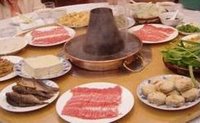
The hotpot is quite popular in Beijing ,especially in cold winter ,the Mongolian hotpot is mainly made with mutton and beef,but now apart from lamb and veal ,chicken,fish or prawn ,in fact ,everything can be used in the pot,and there are also some vegetables,bean-noodles,mushrooms,Chinese cabbages and bean-curd together with the hotpot, ou put them in to the boiling water in the hotpot by youself ,so people also call it do it youself style ,the sauce is prepared personally by the diner ,you may want hot,sweet or salty selection,the traditional food toaccompany the hotpot is sesame pancake or noodles,now Sichuan style spicy hotpot is also very popular in Beijing .
2007/03/08
City Layout of Bejing
Neighbourhoods
Major neighbourhoods in urban Beijing include the following. Neighborhoods may overlap across multiple districts (see below):
* Andingmen 安定门
* Beiyuan 北苑
* Chaoyangmen 朝阳门
* Dongzhimen 东直门
* Fangzhuang 方庄
* Fuchengmen 阜成门
* Fuxingmen 复兴门
* Guomao 国贸
* Hepingli 和平里
* Wangjing 望京
* Wangfujing 王府井
* Wudaokou 五道口
* Xidan 西单
* Yayuncun 亚运村
* Zhongguancun 中关村
Several place names in Beijing end with men (门), meaning "gate", as they were the locations of gates in the former Beijing city wall. Other place names end in cun (村), meaning "village", as they were originally villages outside the city wall.
Towns
Towns within Beijing Municipality but outside the urban area include:
* Changping 昌平
* Huairou 怀柔
* Miyun 密云
* Liangxiang 良乡
* Liulimiao 琉璃庙
* Tongzhou 通州
* Yizhuang 亦庄
Subdivisions
Beijing Municipality currently comprises 18 administrative sub-divisions, county-level units governed directly by the municipality (second-level divisions). Of these, 16 are districts and 2 are counties.
The urban and suburban areas of the city are divided into eight (8) districts:
Dongcheng District (东城区,population 536,000)
Xicheng District (西城区,707,000)
Chongwen District (崇文区,346,000)
Xuanwu District (宣武区,526,000)
Chaoyang District (朝阳区,2,290,000)
Haidian District (海淀区,2,240,000)
Fengtai District (丰台区,1,369,000)
Shijingshan District (石景山区,489,000)
City proper + inner suburbs 8.50 million
The following six districts encompass the more distant suburbs and satellite towns, constituting part of the metropolitan area:
Mentougou District (门头沟区)
Fangshan District (房山区)
Tongzhou District (通州区)
Shunyi District (顺义区)
Changping District (昌平区)
Daxing District (大兴区)
The other two districts and the two counties located further out govern semirural and rural areas:
Pinggu District (平谷区)
Huairou District (怀柔区)
Miyun County (密云县)
Yanqing County (延庆县)
Beijing's 18 districts and counties are further subdivided into 273 lower (third)-level administrative units at the township level: 119 towns, 24 townships, 5 ethnic townships and 125 subdistricts.
标签: beijing
Beijing--Chinese capital
Beijing, the capital of the People's Republic of China, is the nation's political and cultural center. Some 690,000 years ago, Peking Man lived at Zhoukoudian, 48 kilometers southwest of Beijing. A small town appeared on the present site of southwestern Beijing in 1045 B. C. It was named Ji and then changed to Yan. At the beginning of the 10th century, it was the second capital of the Liao Dynasty. From then on, the city had been the capital of the Jin, Yuan, Ming and Qing dynasties until 1911. In the early twenties, Beijing became the cradle of China's new democratic revolution. The May Fourth Movement against imperialism and feudalism began here in 1919. On October 1st, 1949, Chairman Mao proclaimed to the whole world the founding of the People's Republic of China.
Population: approx 14,000,000 fluctuating daily
The total municipal area: over 17,800 square kilometers
Administrative districts of Beijing municipality: total 2 suburban counties(Miyun and Yanqing) and 16 urban districts including Dongcheng, Xicheng, Chongwen, Xuanwu, Chaoyang, Haidian, Shijingshan, Fengtai, Shunyi, Changping, Mentougou, Tongzhou, Fangshan, Daxing, Huairou and Pinggu.
Beijing city trees: the scholar tree and oriental cypress
Beijing city flowers: the Chinese rose and the chrysanthemum
2007/03/07
Great Wall

Despite the common assumption, the Great Wall can not be seen from the moon; it can, however, be viewed from astronauts in passing orbiters. It was also not built all at one, ti was built from the 5th to 16th centuries to be completed as a barrier against nomadic invaders from the north. The wall's origins date back at least to the 5th century b.c., when the rival kingdoms of the Warring States Period (453-221 b.c.) built defensive ramparts against their enemies. The First Emperor of unified China, Qin Shi Huang Di, fortified the barriers in the 3rd century b.c. Over a 10-year period, 300,000 conscripted laborers, many of them slaves, knit the walls into a continuous rampart to protect the western frontier. New sections extended the wall east to the Yellow Sea.
The Great Wall was constantly repositioned along new routes as successive dynasties rose and fell. In the year a.d. 607, more than a million workers toiled on this line of defense, but soon after the Great Wall was abandoned. The Mongols eventually broke through from the north and established the Yuan Dynasty (a.d. 1271-1368), making Beijing their capital. Their successors, the emperors of the Ming Dynasty (a.d. 1368-1644), set in motion the last great phase of wall building, which created the Great Wall as we see it today north of Beijing.
Its eastern foot rests in the Gulf of Bohai on the edge of the Yellow (or Eastern) Sea, its western 5,000km (3,333 miles) on the verges of the desert region.
Visitors to Beijing can visit the Wall at three locations: Bakaling, 80km north; and Simatai, 110km northeast. Built during the Ming Dynasty, the Badaling section is 7.8 meters high and 5.8 meters wide. While the ridge can be accessed on foot, the steep ascent is not for everyone and a cable car ride can be substituted.
Another restored sector, at Mutianyu, can also be explored by foot up its long, steep stairs and restful terraces or by a recently installed cable car. Both sides are often crowded, which has been left in its ruined state. However, while visitors to the two restored areas can go by tour bus, those traveling to Simatai must have their own guide and means of transprotation.
One day city tour- forbidden city, summer palace, temple of heaven
One day tour to great wall and ming tombs
Hutong tour- listen to Old Beijing story
Beijing Night tour
Vehicle renting in beijing
Personal customized Tour with professional tour guide
标签: beijing, china, great wall
Great Wall China Beijing
One day city tour- forbidden city, summer palace, temple of heaven
One day tour to great wall and ming tombs
Hutong tour- listen to Old Beijing story
Beijing Night tour
Vehicle renting in beijing
Personal customized Tour with professional tour guide
标签: beijing, china, great wall, video
2007/03/02
Green Olympics dream coming true
Beijing is on its way to realizing its dream of staging a "Green Olympics" by succeeding in disposing of 90 percent of its urban sewage in the proper manner before schedule.
To date more than half of the treated wastewater, or 360 million cubic meters, has been reused both in the agricultural and industrial sectors, especially in cooling towers of power plants.
Beijing Water Authority chief Jiao Zhizhong said yesterday: "We are confident that Beijing's water environment would reach, or even surpass, Olympic standards before the 2008 Olympic Games begin."
Beijing will increase its urban wastewater treatment rate to 92 or 93 percent this year by completing five more wastewater treatment plants in some urban as well as suburban areas, Jiao said.
New technologies will be introduced to improve the quality of the disposed wastewater because the authority's goal is to increase the volume of recycled water being used to 480 million cubic meters, or one-tenth of the city's water supply.
Also, the official said, more than 2.16 million rural residents, or 65 percent of the capital's total rural population, had access to safe drinking water by the end of 2006.
"Another 300,000 rural residents will have access to safe drinking water within this year."
And as part of the authority's "Green Games" efforts, Jiao promised to clean all the canals, moats and lakes within the Sixth Ring Road, too.
"This year we will ensure that the clean ones stay clean and continue treating the rest, including the lower reaches of Qinghe River near the main venue."
Beijing follows standard ecological norms while cleaning its rivers and lakes. "We don't change the natural course of rivers and ensure that their diverse plant and animal life is not disturbed,"
But despite all the authority's efforts Beijing still suffers from acute water shortage.
"Among the methods we've adopted to solve the problem are strict water resources protection and management, search for new water sources, minimizing waste and a rationed supply policy."
Eighty percent urban homes in Beijing have installed water-saving equipment; 332 water-saving technologies have been applied in industries; water-shaving cropland has increased to 20,000 hectares and 300 rainwater-recycling projects have been set up. All this, he said, shows "Beijing is doing remarkably well in reducing water consumption".
By the time the Olympics open next year, Beijing would already have started getting 300 million cubic meters of water a year from four reservoirs in neighboring Hebei Province.
And by 2010, the city would get another 1 billion cubic meters of water from the Yangtze River.
标签: beijing, beijing2008, china, olympic